Well, I’m not sure I can add a whole lot more to this true story, but here are a few ringtail facts that are fun. Okay, fun for nature geeks like you and me.
The scientific name of the ringtail is Bassariscus astutus. It’s in the Procyonidae, the same family as our local borderlands’ critters the raccoons and coatis. Further south into the tropical forests of Central America there is another species, Bassaricus sumichrasti ,with the common name of cacomistle. I learned that that name is sometimes applied to our local ringtails (common names do tend to travel) and that the name is derived from a nahuatl word. How cool is that? Very.
Oh and did you know that ringtails are the Arizona State Mammal? It occurs all over the state, usually below 6,000’ in elevation. And actually it’s found all over the southwest. I’m surprised it’s not the state mammal of other states, because they are so dang cute! Oh, and did I mention that they can read? Ha!
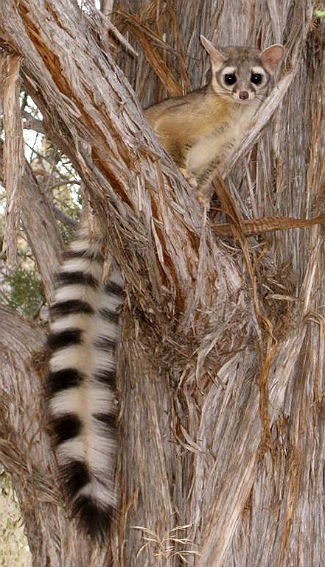
The photo of the ringtail on the branch of the juniper is by Robert Brody. And below that you’ll find a link to a video of some frisky ringtails courtesy of my friend Russ McSpadden at the Center for Biological Diversity. Cool!
https://www.facebook.com/CenterforBioDiv/videos/10155615218195460/
Leslie Newton Goodding had a busy career. It was when he worked for the U. S. Department of Agriculture that he collected the type...
The specific epithet ligusticifolia for this Clematis means that the plant has leaves like Ligusticum or lovage. I used the name Levisticum for lovage...
I have two books on my shelf about desert bighorns. The Desert Bighorn, It’s Life History, Ecology and Management. Edited by Gale Monson and...